Why Sub-Second Page Speed is the #1 Growth Factor in 2026
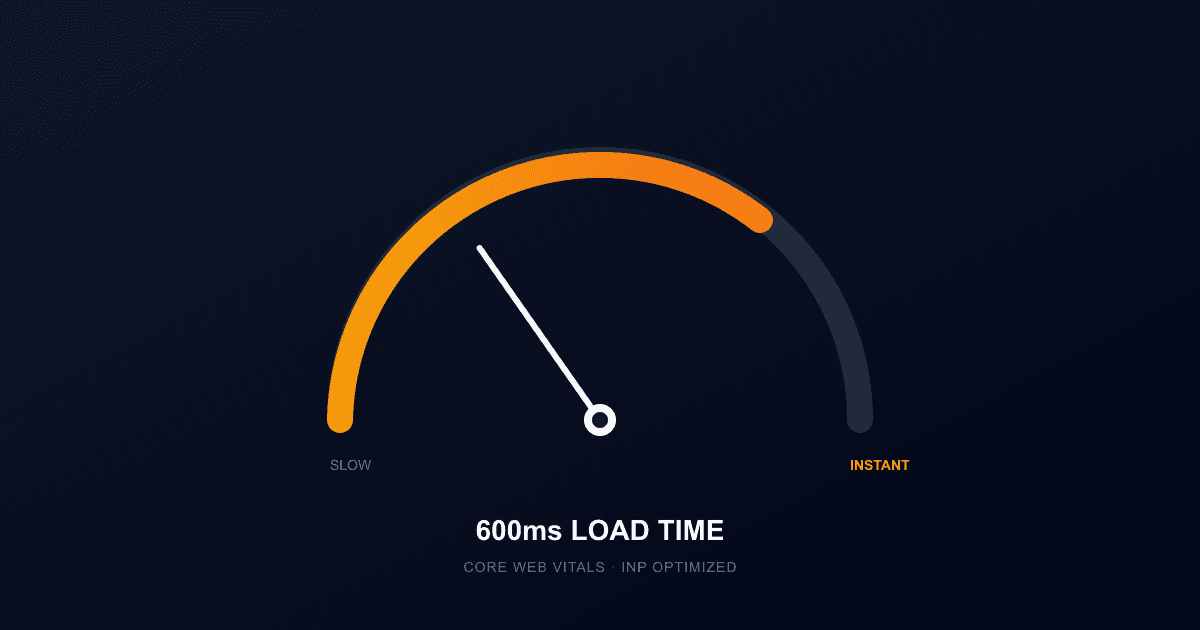
User patience is measured in milliseconds. Google's Core Web Vitals, and INP (Interaction to Next Paint) in particular, are not just a ranking checkbox anymore, they are a reasonable proxy for whether a visitor trusts your site enough to keep browsing, fill out a form, or complete a purchase.
What Core Web Vitals actually measure
Core Web Vitals track loading speed, visual stability, and how quickly a page responds to a tap or click, not how a site looks in a screenshot, but how it feels to actually use. INP replaced First Input Delay as Google's responsiveness metric in 2024, and it is noticeably less forgiving of heavy client-side JavaScript.
The Real Cost of a Slow Page, in Business Terms
A visitor doesn't consciously decide a page is "2.8 seconds slow," they just feel like the site is sluggish and leave, often before the content even has a chance to make its case. That first impression forms in a window of a few seconds, and it's already happening before most visitors consciously register load time at all, they're reacting to it, not measuring it. For a lead-generation site, that's a form nobody opens. For an e-commerce storefront, it's a cart nobody fills. The revenue impact is real even when it never shows up as a line item anyone can point to, because a slow site doesn't generate a support ticket, it just quietly generates fewer conversions than a fast one would have from the same traffic.
Mobile Makes the Patience Problem Worse, Not the Same
Google indexes and ranks primarily using the mobile version of a page, and mobile is also where the gap between a fast site and a slow one is most visible, slower processors, inconsistent network conditions, and a smaller screen all compound the cost of unnecessary JavaScript and unoptimized images. A site that feels merely average on a developer's desktop machine and fast office wifi can feel genuinely broken on a mid-range phone on a mobile network, which is exactly the condition a meaningful share of real visitors are in. Treating a mobile Lighthouse score as a formality to check after the desktop version ships is how that gap goes unnoticed until it shows up as a failing report in Search Console.
How We Keep Sites Fast at Portage Now
We build on Next.js with server-side rendering and route-level code splitting, so a visitor's browser only downloads the JavaScript the page they're actually on needs, not the entire site's worth of code up front. We treat image weight as a first-class engineering problem rather than an afterthought. Running one of our own portfolio screenshots through Next.js's built-in image optimization, automatic resizing plus WebP and AVIF re-encoding, took it from 2.1MB down to 66KB with no visible loss in quality. That is the kind of unglamorous work that actually moves Core Web Vitals scores, not a single dramatic fix but a series of specific, checkable decisions.
Building a Performance Budget Into the Brief, Not Bolting It On Later
Industry research consistently links faster load times to lower bounce rates and higher conversion, even though the exact numbers vary by industry and audience. The practical takeaway is that a performance budget belongs in the brief from day one of a build, explicit LCP, INP, and CLS targets treated as real acceptance criteria, the same as a design requirement or a feature list. When a new feature request threatens one of those targets, that's a scope conversation to have before it ships, not a regret to have after a launch that quietly got slower with every addition. Performance treated this way holds up over the life of a site; performance treated as a final cleanup pass before launch is the first thing sacrificed when a deadline gets tight.
If your current site feels sluggish, especially after a redesign or a platform change, a focused performance and Core Web Vitals audit is usually the fastest way to find out exactly what is slowing it down, it is one of the engagements listed on our Services page.
Frequently Asked Questions
Let’s Build Something Great Together
Transform your ideas into a powerful online experience with high-performance web engineering and seamless migrations.